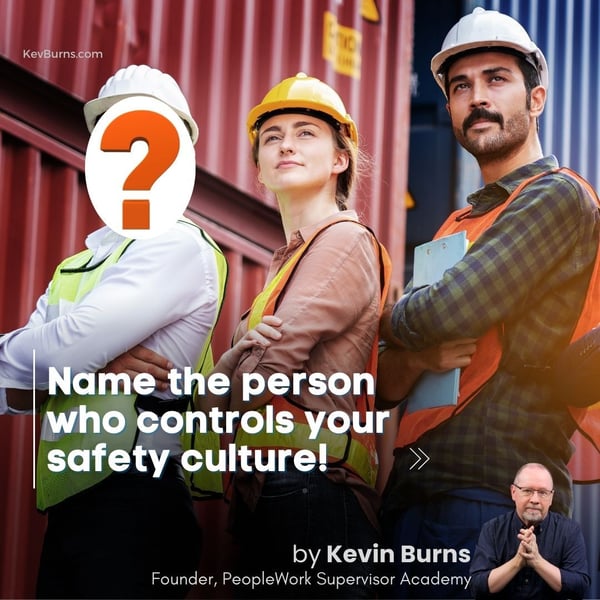
Every safety program talks about "people" doing things right. Procedures target "people." Behavior-based safety observes "people." The hierarchy of controls protects "people." But ask any anyone to identify exactly which people have the most control over safety culture, and they'll talk about engagement, systems, and culture—anything to avoid naming the specific person who determines whether safety works or fails. And that avoidance isn't accidental. It's deliberate. Because naming that person means admitting your approach has been wrong.
Professional hockey players don't forget their padding or gloves. Football players don't leave their helmets in the locker room. These athletes treat their protective equipment like non-negotiable tools of their trade because they're professionals with professional expectations. They know exactly what's required to perform at an elite level, and they deliver it every single time.
So why do your team members "forget" their safety glasses? Why does PPE mysteriously disappear from job sites? Why do employees need constant reminding about basic protective equipment?
The answer isn't in your hierarchy of controls chart. It's in how you're treating the people wearing that equipment.
A Favorite Distraction: Systems Over People
Let's talk about the hierarchy of controls. Elimination, substitution, engineering controls, administrative controls, and finally PPE as the "last line of defense."
But ask yourself this simple question: Who exactly is this hierarchy referring to? Who's doing the eliminating? Who's implementing the engineering controls? Who's enforcing the administrative procedures? No, the answer is not "everyone."
In fact, the hierarchy of controls doesn't answer that question. It's deliberately impersonal. Just like behavior-based safety programs that track "behaviors" without identifying whose behaviors matter most. Just like "safety complacency" that blames an entire workforce instead of asking why specific teams under specific supervisors are disengaged.
Here's the truth about complacency: your whole company isn't becoming complacent at the same time. A few teams are. And those few almost always fall under a handful of supervisors who lack the skills to lead their teams and build high levels of engagement and professionalism.
But it's easier to call it complacency than to admit "we have supervisors who don't know how to keep their teams engaged." One sounds like a culture issue that requires another awareness campaign. The other requires actually developing people, which is uncomfortable work.
As I wrote in PeopleWork: The Human Touch in Workplace Safety, "Most safety programs focus on the Three Ps: Procedures, Programming, and Production. These are easily replicated and adjusted to fit any function, job site, or place of employment. However, one P is missing from this list...the fourth P, which is most important in the new safety model," is People.
You've spent decades building elaborate systems that avoid the uncomfortable work of dealing with people (ick!). Processes feel safe. Procedures are measurable. Rules can be enforced. But relationships? Those are messy. Those require icky soft skills.
The PPE Problem Nobody Wants to Discuss
When team members forget their PPE or "can't find" their safety equipment, that's not a compliance problem. That's a relationship problem.
Think about those pro athletes again. They don't need someone following them around with a checklist. They don't need behavior-based observation programs. They show up ready to perform because they're part of a team with clear expectations, and they respect their role enough to meet those standards.
Your team members aren't showing up like professionals because they're not being treated like professionals. They're being treated like children who need constant supervision and threats to follow basic rules.
The difference isn't in your safety manual. It's in the relationship between your frontline supervisors and their teams.
Where Safety Actually Lives
Safety culture doesn't live in your procedures manual, your behavior-based safety program, or your hierarchy of controls. Safety culture lives in the daily relationship between frontline supervisors and their team members.
When supervisors build strong relationships with their crews, something remarkable happens. Team members start showing up like professionals. They don't "forget" their equipment. They don't look for shortcuts. They hold each other accountable because they actually care about the people working beside them.
As I explain in The CareFull Supervisor, "What's important to the supervisor will eventually become what is most important to the team."
But it requires supervisors who have actual leadership skills. Not just surface-level safety leadership classes, but full skills development in how to lead, how to coach, how to communicate, how to listen and hear, how to connect—all the messy stuff that isn't being addressed. You need supervisors who can build trust and respect. Supervisors who understand that their job is coaching people, not just handing out tasks and enforcing rules.
Why Have You Been Avoiding This Truth
You focus on processes and procedures because it's easier than dealing with the messy reality of human relationships. It's easier to create another checklist than to develop people skills. It's more comfortable to launch a complacency awareness campaign than to admit that your supervisors lack the relationship skills to keep their teams engaged - and then search out a solution.
The hierarchy of controls, behavior-based safety, complacency initiatives, and endless procedures all have one thing in common: they're impersonal. Every time you talk about "people" doing things right, you never identify which people. You never develop a strategy for reaching those specific people. Because identifying those people means admitting an uncomfortable truth: frontline supervisors are the linchpin of your entire safety program, and most of them have never been properly trained to lead.
The Real Solution Nobody Wants to Hear
If companies invested the same time, effort, and resources into developing their frontline supervisors' leadership skills that they currently invest in creating and implementing procedures and programs, most safety culture issues would solve themselves.
You wouldn't need to blame hundreds of employees for not following procedures. You'd recognize that a few supervisors who train and lead those employees are the ones who need development.
You wouldn't need endless behavior-based observation programs. You'd have supervisors who build relationships strong enough that team members naturally hold each other accountable.
You wouldn't need complacency campaigns. You'd have supervisors who know how to keep their teams engaged, motivated, and performing at professional levels.
You wouldn't need to treat PPE as a compliance battle. You'd have crews that show up like professionals because their supervisors set professional expectations and build the relationships that make people want to meet those standards.
And as I wrote in my last post, when you develop supervisors' fundamental people-leadership skills, you're not just impacting safety culture. You're impacting every metric that's influenced by how well supervisors can lead their teams:
- Safety performance
- Turnover rates
- Productivity
- Engagement scores
- Change adoption speed
- Training effectiveness
- Absenteeism
- Quality issues
- Customer complaints
- Succession pipeline
- Time to competency
- Supervisor retention
Stop Building Systems That Avoid the Solution
Your company doesn't have a PPE problem. It doesn't have a complacency problem. It doesn't have a procedure problem. It doesn't need another behavior-based safety program or a revised hierarchy of controls.
Your company has a supervisor development problem.
Until you invest in giving your frontline supervisors the relationship skills, communication skills, and leadership skills they need to build strong teams, you'll keep spinning your wheels with impersonal systems that don't address the real issue.
The solution isn't hard. It's just uncomfortable. Because you've been so busy avoiding the actual work of developing the people who lead your teams.
At PeopleWork Supervisor Academy, we've trained over 1,000 supervisors in the leadership skills that actually build strong safety cultures. Not through more procedures or programs, but through developing the relationship and communication skills that make everything else work. Because once supervisors know how to lead their teams effectively, safety stops being a compliance battle and becomes what it should be: a natural outcome of strong leadership.
The choice is yours. You can keep investing in impersonal systems that give you the illusion of progress. Or you can invest in developing the one group of people who actually determine whether your safety program succeeds or fails: your frontline supervisors.
Professional athletes don't forget their equipment because they're professionals with professional expectations. Your team members will show up the same way when they have supervisors who know how to build those expectations through strong relationships.
Everything else is just avoiding the real work.