You can't build a safety culture by only focusing on safety. Here's the leadership problem that's driving your incident rate, AND turnover, AND productivity, AND engagement, AND a dozen other problems ... including safety.
Here's what many in the safety industry won't tell you, or simply don't realize: you can't build a safety culture by focusing solely on safety.
I know that sounds backwards. You've been told for years that safety requires dedicated safety training, safety programs, safety committees, and safety-focused leadership. The entire industry is built on this idea.
But it's wrong.
Safety culture isn't something you build directly. It's a by-product of something much more fundamental: frontline supervisors who know how to lead their frontline people.
The Problem With Safety-Only Thinking
Walk into any industrial company, and you'll find the same pattern. They've invested heavily in safety programs. They've hired safety consultants. They've rolled out new initiatives with great fanfare. And their incident rates have barely budged.
Why? Because they're treating safety as a separate discipline that requires separate solutions.
They send supervisors to safety training where they learn OSHA regulations, hazard recognition, and incident investigation procedures. Then those supervisors go back to the floor, and, surprise, nothing changes. The crew still takes shortcuts. Team members still don't speak up about hazards. The same incidents keep happening on the same crews.
The problem isn't the safety training. The problem is that safety training doesn't address the real issue: your frontline supervisors don't know how to lead their people.
And here's why this matters more than you think.
Why Senior Management Seems Checked Out on Safety
Safety departments often complain that senior management doesn't get behind safety programs. They see lukewarm support, delayed decisions, and competing priorities that always seem to win.
But here's what's really happening: senior management isn't just thinking about safety. They're thinking about productivity, turnover, efficiency, engagement, and a dozen other metrics that determine whether the company succeeds or fails.
When the safety department asks for investment in another safety program, they're asking executives to solve one problem. When that executive looks at their dashboard, they see twelve problems that all need attention.
This is why safety-only solutions struggle to get traction at the executive level. Not because senior management doesn't care about safety, but because they need solutions that move multiple needles at once.
The Multi-Metric Reality
Here's a question worth considering: when you look at your operations dashboard, how many metrics are you tracking?
Most senior leaders are monitoring somewhere between twelve and twenty key indicators. Safety performance is on that list, certainly. But so are turnover rates, productivity numbers, engagement scores, and a lot more.
When you develop supervisors' fundamental people-leadership skills, you're not just impacting safety culture. You're impacting every metric that's influenced by how well supervisors can lead their teams:
- Safety performance
- Turnover rates
- Productivity
- Engagement scores
- Change adoption speed
- Training effectiveness
- Absenteeism
- Quality issues
- Customer complaints
- Succession pipeline
- Time to competency
- Supervisor retention
Look at that list. Which of those twelve outcomes wouldn't positively affect your safety culture?
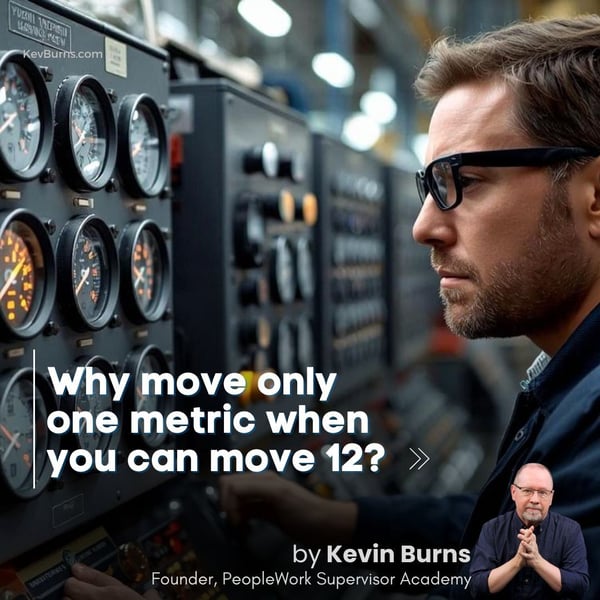
Now ask yourself: why would you want a solution that moves only one metric (maybe), when you could have a solution that moves twelve?
What Actually Creates Safety Culture
Safety culture emerges from the thousands of daily interactions between supervisors and their crews. It's built in moments you can't program or policy your way through.
When a supervisor notices someone's distracted and asks what's going on out of care - that's safety culture.
When workers trust their supervisor enough to speak up about anything - that's safety culture.
When a crew does safe work even when no one's watching because they respect their supervisor and each other - that's safety culture.
When a supervisor can marry safety and production instead of treating them as competing priorities - that's safety culture.
None of that comes from safety training. It all comes from fundamental people leadership skills.
The Skills That Matter
Think about the supervisors in your operation who run the safest crews. What makes them different?
- They know how to build trust. Their people aren't afraid to admit mistakes or ask questions. This doesn't just reduce incidents - it improves engagement scores and reduces turnover.
- They communicate clearly and consistently. Everyone knows what's expected and why it matters. This drives productivity and quality while reducing errors.
- They make people feel valued as individuals, not just as production units. When people know their supervisor cares about them, they show up (lower absenteeism), they stay (lower turnover), and they care about staying safe.
- They create accountability without creating fear. Standards get followed because the supervisor has earned respect, not because workers are scared of getting written up. This builds the foundation for successful change adoption.
- They lead by example every single day. They don't ask their crew to do anything they wouldn't do themselves. This creates the succession pipeline - people want to become the kind of leader they respect.
- They can coach people through problems instead of just telling them what to do. This builds capability and confidence across the whole team, reducing time to competency and improving training effectiveness.
These aren't safety skills. These are people leadership skills. And when supervisors have these skills, safety performance improves as a natural consequence - along with every other metric that matters, including safety.
Why This Matters for Your Bottom Line
Sure, your incident rate is costing you money. But so is your turnover rate, your productivity gaps, your failed improvement initiatives, and your engagement problems.
Safety-only consultants can only help with one of those issues - and often they don't even succeed at that because they're not addressing the real problem.
When you invest in developing your supervisors' people leadership skills, you're not just buying safety culture.
- You're buying better retention that saves you six figures per supervisor in replacement costs.
- You're buying higher productivity that improves your margins.
- You're buying change capability that lets you adapt and improve.
- You're buying engagement that reduces the daily friction that slows everything down.
Safety culture is part of the package, but it's not the whole package.
You're Already Paying for Supervisor Development
Let's say it again: you can't build safety culture by only focusing on safety. You build it by developing supervisors who can lead people, which creates the organizational health that makes safety culture possible.
Here's the hard truth: you're already writing a check for supervisor development.
You can write the check proactively by investing in training that develops your supervisors' people-leadership skills.
Or you can write the check reactively, paying for the fallout from under-skilled supervisors.
Either way, you're writing a check.
That fallout is expensive.
- Six-figure replacement costs every time a good supervisor burns out or a crew member quits.
- Incident costs that hit your insurance rates and your reputation.
- Productivity losses from crews that underperform.
- Failed improvement initiatives that waste time and money.
- Engagement problems that create daily friction across your operation.
Add it up. You're already spending a fortune on the consequences of poor supervision.
Supervisor development isn't a new expense. It's redirecting money you're already losing into an investment that actually fixes the problem.
The only question is whether you'd rather pay on the front end or the back end. Front-end costs less and builds capability. Back-end costs more and builds nothing.
The Solution: Deep Leadership Development
We're not teaching surface-level "safety leadership." We're going much deeper than that.
The PeopleWork Supervisor Academy develops actual frontline leaders who, as a result of their deep skill-set, happen to dramatically improve many other positive outcomes, including safety.
Over 8 weeks of intensive learning followed by our 50-week ongoing support program, your supervisors develop the fundamental people-leadership capabilities that move the needle across the board:
- Building genuine trust with their teams
- Communicating clearly and consistently
- Creating accountability without fear
- Coaching and developing their people
- Leading by example in every interaction
- And doing it in under 10-minutes a day (zero operational disruption)
This isn't a safety program with a few leadership tips added on. This is leadership development that creates the organizational health where safety culture and everything else can thrive.
Your supervisors become leaders who create the conditions where people choose to work safely, stay with the company, perform at high levels, and embrace change.